Why Water Is the Biggest Threat to Tampa-Area Chimneys
Ask most homeowners what they're worried about with their chimney and they'll say fire. That's understandable — chimney fires are dramatic and frightening. But the more common, more insidious threat to chimneys in the Tampa area is water.
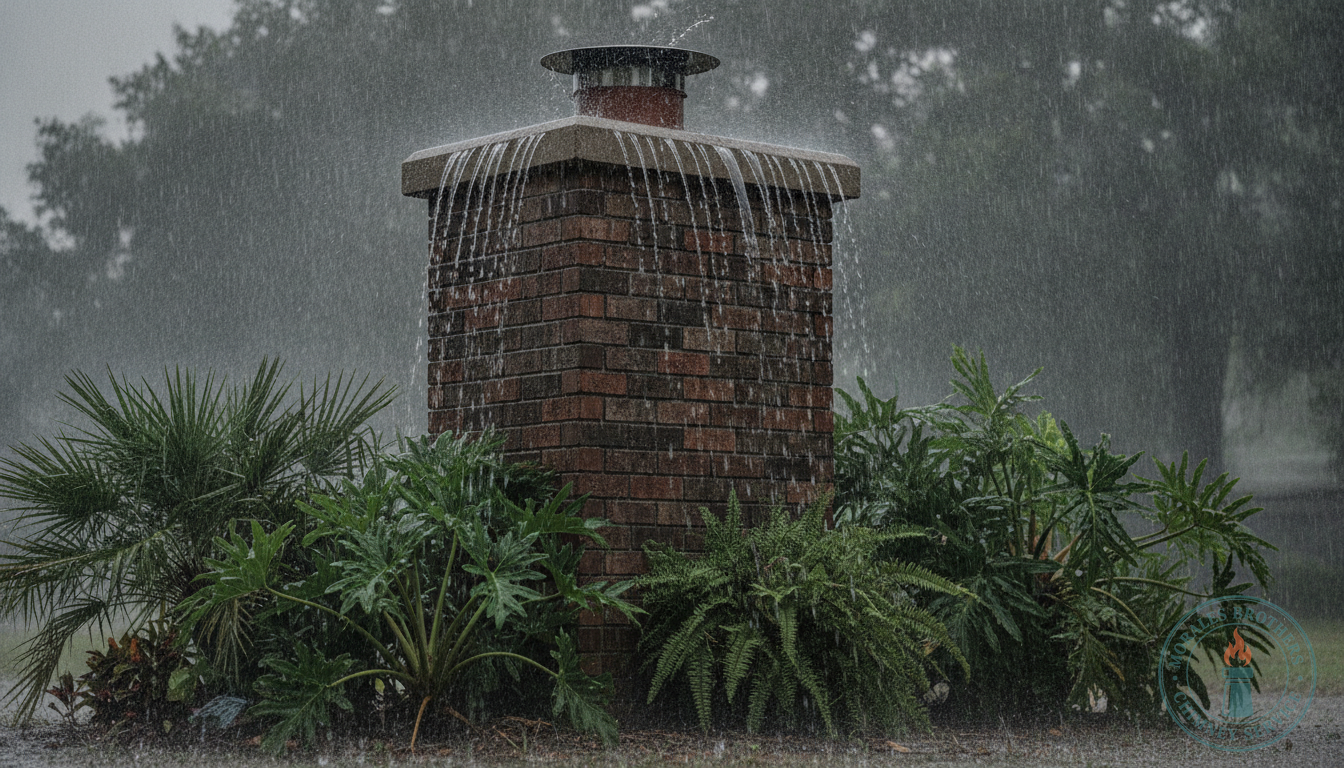
Tampa averages more than 46 inches of rainfall per year, with the bulk of it falling during a summer rainy season that runs from June through September. During that period, afternoon thunderstorms can dump one to three inches of rain in a matter of hours. Any chimney system that isn't properly sealed against water intrusion will absorb significant moisture during those storms — moisture that rusts metal components, saturates and degrades masonry, cracks flue liners, and can even soak into the framing and drywall surrounding the chimney chase.
Three components of your chimney system are specifically designed to prevent this: the chimney cap, the chimney crown, and the fireplace damper. At Morales Brothers Chimney Service, we inspect, repair, and replace all three across Tampa and the surrounding Hillsborough County communities. Here's what each one does — and how to tell if yours is failing.
The Chimney Cap: Your Flue's First Line of Defense
The chimney cap is the metal cover that sits directly over the top of the flue opening. Think of it as an umbrella for your chimney's throat. A properly installed cap performs several important functions simultaneously:
- Blocks direct rainfall from pouring straight down into the flue and onto the damper, firebox, and liner below.
- Prevents animal and bird entry — the mesh skirt surrounding the cap opening stops squirrels, raccoons, birds, and other wildlife from nesting inside the flue.
- Stops wind-driven debris such as leaves and twigs from accumulating inside the chimney and creating fire hazards or blockages.
- Acts as a spark arrestor — the mesh screen prevents burning embers from escaping the flue and landing on your roof or neighboring properties.
Chimney caps are available in galvanized steel, 304 stainless steel, and copper, in single-flue and multi-flue configurations. Galvanized caps are the least expensive option but have a shorter lifespan in Florida's corrosive, salt-air coastal environment. Stainless steel caps are the most practical choice for most Tampa homeowners, offering excellent corrosion resistance and longevity. Copper caps are a premium aesthetic option that develops an attractive patina over time.
If your home doesn't have a chimney cap — or if the existing cap is rusted, damaged, or has gaps in the mesh — this is one of the most cost-effective upgrades you can make. Our chimney cap and crown installation service includes supply and installation of the appropriate cap for your flue size and configuration. Homeowners in Town 'N' Country and Carrollwood should be especially attentive to cap condition given the mature tree canopy in those neighborhoods — debris intrusion is a common issue.
The Chimney Crown: Sealing the Top of the Masonry Stack
While the cap protects the flue opening itself, the chimney crown protects everything else at the top of the masonry chimney stack. The crown is the concrete or mortar slab that covers the entire top surface of the chimney, surrounding the flue tiles and sloping outward to direct water away from the masonry below.
A properly formed crown has two critical design features: a wash slope (a slight downward angle from the flue collar toward the edges of the chimney) and a drip edge (a lip or overhang that causes water to drip clear of the chimney face rather than running down the bricks). Many original crowns poured on Tampa-area homes lack one or both of these features, resulting in crowns that hold water, crack under expansion and contraction stress, and eventually fail.
When a chimney crown cracks — even slightly — water enters the gap and works its way into the masonry below. Each rain event pushes water deeper into the structure. In Tampa's climate, that water also carries with it the humidity and organic material that promotes mold growth inside the chimney chase. By the time a homeowner notices interior water staining near the chimney, significant damage has often already occurred.
Our technicians evaluate crown condition during every chimney inspection. When a crown has failed beyond sealant repair, we remove it entirely and form a new one with the correct slope and overhang geometry — a repair that, when done properly, can last decades. This service is particularly relevant for homeowners in Temple Terrace and Gibsonton, where many homes were constructed with original-era chimney crowns that are now overdue for replacement.
The Fireplace Damper: Sealing the Flue from the Inside
The chimney cap and crown handle water from the top down. The fireplace damper handles it — and energy loss — from the bottom up. The damper is the movable plate located inside the chimney, either just above the firebox opening (a throat damper) or at the very top of the chimney stack (a top-mount damper). Its job is to open when you have a fire burning and close tightly when the fireplace is not in use.
In Tampa's climate, a failing damper creates problems even during the months when your fireplace sits unused — which, in Florida, is most of the year. A damper that won't seal properly allows:
- Warm, humid outside air to flow continuously into the home through the flue, raising indoor humidity and making your air conditioning work harder.
- Conditioned indoor air to escape up the chimney, increasing energy costs.
- Moisture-laden air to condense on the cooler interior surfaces of the flue, accelerating liner deterioration and promoting mold growth.
Traditional throat dampers, made of cast iron or steel, are prone to warping from heat exposure and corrosion from moisture — both extremely common in Florida. When a throat damper no longer seals properly, we often recommend replacement with a top-mount damper rather than a like-for-like throat damper swap. A top-mount damper installs at the crown of the chimney and seals the entire flue opening with a rubber gasket, providing a dramatically tighter seal. It also functions as a chimney cap, combining two protections into one component.
Learn more about our fireplace damper repair and replacement service, and ask our technicians how a top-mount damper installation can be paired with a new chimney crown for a fully integrated weather-sealing solution.
How to Tell If Your Cap, Crown, or Damper Is Failing
You don't need to climb on your roof to spot early warning signs. From the ground and inside your home, watch for:
- Water stains on the ceiling or walls adjacent to the chimney chase
- Rust stains on the interior of the firebox or on the firebox floor
- A drafty feeling near the fireplace opening even when the damper is supposedly closed
- Visible daylight or debris visible when looking up into the firebox from below
- Animal sounds or nesting material inside the flue
- White efflorescence staining on the chimney exterior
- Higher-than-normal air conditioning costs during summer months
If you notice any of these signs, the appropriate next step is a professional inspection. Our chimney inspection service in Tampa gives you a complete diagnostic picture — including a video scan of the flue interior — so you understand exactly what's happening inside your chimney system before any repair work begins.
Schedule Your Assessment with Morales Brothers Chimney Service
Morales Brothers Chimney Service serves homeowners throughout Tampa and the greater Hillsborough County area, including Riverview, Carrollwood, Town 'N' Country, Temple Terrace, Gibsonton, and beyond. We're available Monday through Sunday, 8:00 AM to 6:00 PM.
Call us at +1 (813) 945-6744, email [email protected], or stop by our office at 6601 Memorial Hwy, Suite 201, Tampa, FL 33615 to discuss cap, crown, or damper service for your home. Don't let another Tampa rainy season pass with an unprotected chimney.